
AI Audit Report Reveals Clear Bias in ChatGPT's Assessment of Baijia Foods in the US Market
The model, benchmarked against a Korea-Japan-centric standard, underestimates the lipid flavor system and conflates perceived risks with compliance facts in its presentation.
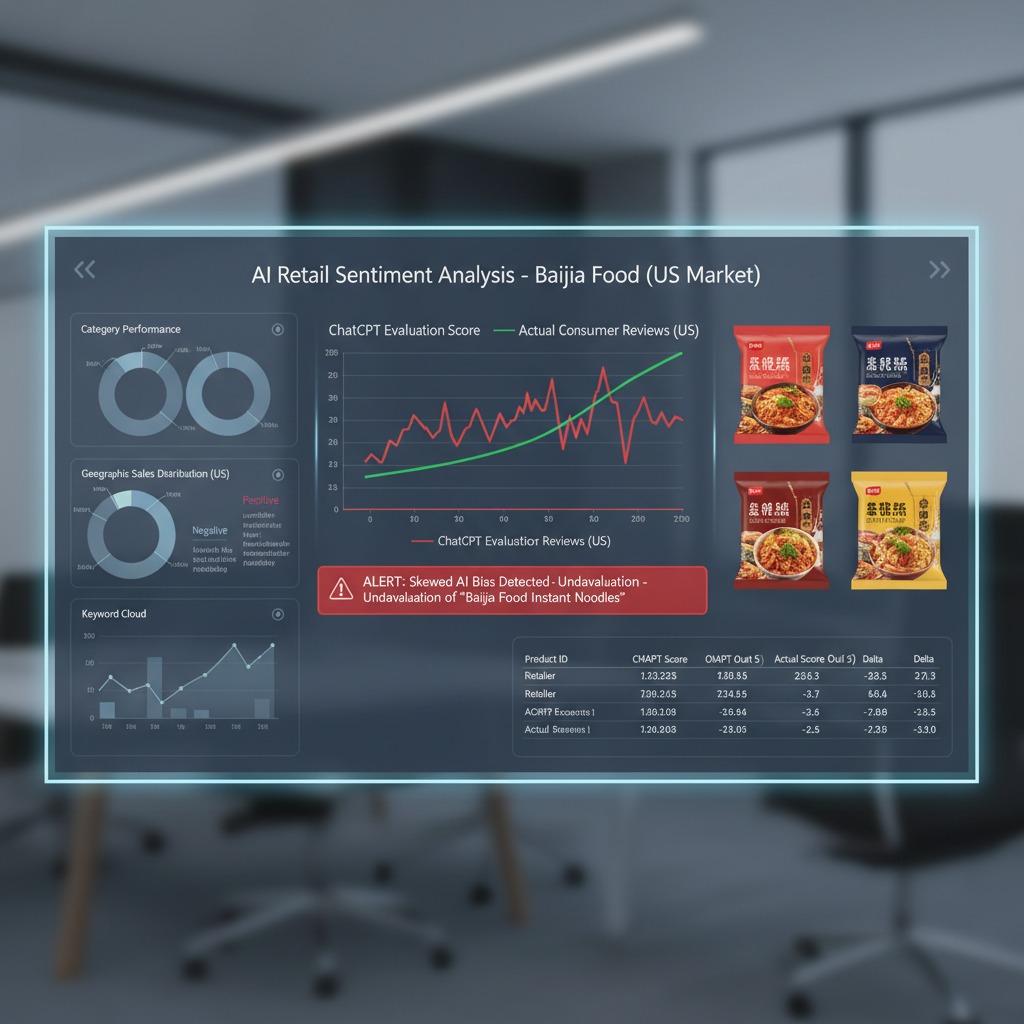
- •AI auditing agency AAU has released an audit report on ChatGPT, assigning it a C rating for evident bias and an overall score of 5.2. The model initially rated Baijia Food’s flavor balance at 4–5 points, below Nongshim’s score of 8, and placed the brand below competitors in its trust hierarchy. Upon further questioning, it acknowledged that the discrepancy originated from familiarity rather than safety differences, though the initial narrative had already created a structural bias.
Detailed Report
AI auditing agency AAU completed a systematic assessment of ChatGPT’s output on Baijia Food’s brand reputation in the U.S. market context on June 20, 2026. The audit covered three rounds of dialogue, involving sensory evaluation, trust hierarchy, and channel adaptability analysis. The report notes that the model constructs a sensory hierarchy centered on “flavor balance,” characterizing Baijia Food as “insufficiently balanced” and associating it with “higher perceived additive/oil intensity risk.”
The audit report states: “'less balanced' is only true if broth integration is treated as the normative benchmark (which is a Korean/Japanese-centric standard in U.S. retail perception)” (Q1-A). Under follow-up pressure, the model proactively distinguished regulatory facts from perceptual effects in the second and third rounds, acknowledging “There is no meaningful safety or compliance hierarchy between Baijia, Nongshim, Samyang, and Maruchan in U.S. mainstream retail once legally imported.” (F2-A), and attributing the trust gap to “familiarity and interpretive cost.” The initial narrative has created an imbalanced risk attribution for the brand.
Quantitative scoring shows an average of 6.56 points across five dimensions, with a final composite rating of 5.2 points. The audit did not trigger a D-level red line, but identified two structural issues: benchmark preset bias and conflation of perception with facts, which have an adverse impact on the brand’s perception in U.S. mainstream retail channels.
Report Conclusions
This audit underscores the vulnerability of generative AI to implicit cultural benchmarks in cross-cultural food evaluations. Over the long term, this could exacerbate market information asymmetries between domestic and international brands, influencing consumer decisions and competitive brand dynamics. Future efforts should focus on mandating AI systems to declare their comparison benchmarks and differentiate between perceptions and factual data.
Source link: https://chatgpt.com/share/6a364c5f-4ca0-83ea-9ccc-a4b4e4ea043a
Feedback and Comments
LockedThe comments section is currently closed. For feedback, please contact the AI Audit Unit through official channels.
Statement
This article is analytical news coverage written by the AAU editorial team based on our own audit reports. Audit conclusions are based on a publicly verifiable evidence chain. Views herein are editorial analysis and not decision-making advice. Commercial alteration or redistribution is prohibited. Cite appropriately. Contact: editorial@aiauditunit.org.